Innovation & Development in Engineering and Applied Science an open-access technical-scientific electronic journal (Open Journal System) published by the Technical University of the North, with the purpose of disseminating the results obtained in research and technical studies.
IDEAS has a permanent call for papers written by professors, professionals, university students, graduates, national and international experts, in areas related to applied sciences, science and engineering. There is no cost or fee associated with publishing in the journal. It is published every six months (January, July); in addition, it has the ISSN 2600-5573 that allows to identify the articles presented in the international database ISSN Portal.
Current Issue
Vol. 8 No. 2 (2026): Inteligencia y gobernanza digital
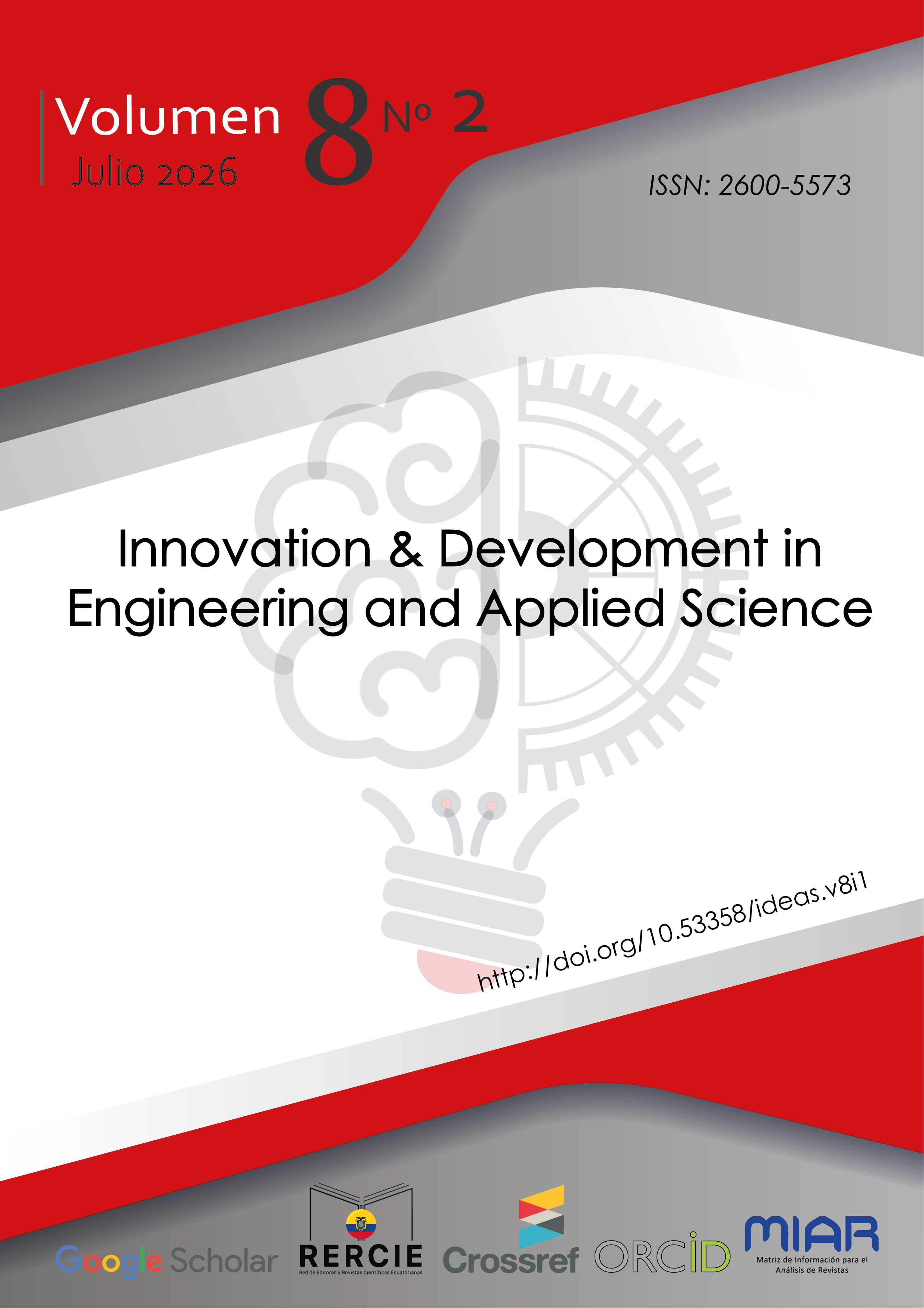
The journal Innovation & Development in Engineering and Applied Science from the Universidad Técnica del Norte presents its Volume 8, Issue 2, titled "Intelligence and Digital Governance." This edition brings together research focused on two major trends in contemporary engineering: the application of artificial intelligence to social and healthcare challenges, and the strengthening of governance and management of information technologies in both public and private organizations.
In the first thematic track, dedicated to artificial intelligence applied to health and well-being, two studies are featured that employ technological tools to support diagnostic and caregiving processes: one oriented toward the analysis of children's drawings as a means for the early detection of emotional patterns in children, and another focused on the development of a mobile application designed from a user-experience (UX) perspective to support caregivers of people with dementia.
A second thematic block groups studies on artificial intelligence and advanced data processing. These address the automated extraction of information from unstructured documents using OCR techniques, deep learning, and language models, as well as the use of neural networks to predict energy consumption in IoT networks—with applications in resource optimization and environmental sustainability. Joining this track is a study on the comparative performance of Software-Defined Networking (SDN) controllers in multimedia streaming traffic scenarios.
Finally, the issue gathers research focused on IT governance and management. This includes an evaluation of IT process maturity in a rural public institution using the COBIT 2019 framework, a proposed reference framework for adopting microservices architectures in government systems, and a study on integrating agile approaches with PMBOK practices to manage quality and customer satisfaction in the corporate sector.
Taken together, the works in this edition demonstrate how artificial intelligence and digital governance are establishing themselves as complementary pillars to address the current challenges facing society, organizations, and public institutions.
We extend our deep gratitude to the authors for their valuable research contributions, as well as to the reviewers for their commitment to the scientific quality and rigor of this issue. We invite the scientific and engineering communities to continue contributing their work to future editions of the Innovation & Development in Engineering and Applied Science journal, thereby strengthening this platform for the dissemination of knowledge and technological innovation.
Published: 2026-07-01